
A gifted educator, and a parent who has seen the gap from both sides.
I have spent fifteen years identifying gifted students, building programs for them, writing their curriculum, and sitting in the meetings where decisions about them get made.
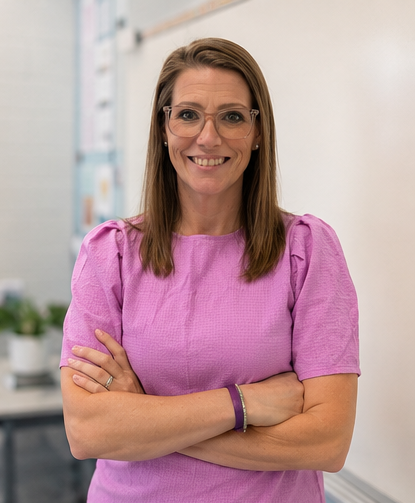
It started at my own kitchen table.
My work in gifted education did not begin on a national stage. It began at home, watching the spark in my own child start to dim in a system that valued pace over depth.
Then I kept seeing it everywhere. Fifteen years in gifted education, and I kept meeting kids who were coasting. Not because anyone was failing them, but because nobody had handed them a problem big enough to need their whole brain.
That turned a personal moment into a professional one. After fifteen years as a classroom teacher, curriculum designer, SEP instructor, virtual gifted educator, center-based gifted teacher, and now gifted coordinator, I founded EverCurious Minds to do this work beyond the walls of any one division.
It is where I sit down with families trying to make a decision about their child, where I speak and train for schools and conferences, and where I build curriculum other teachers can pick up and run.
Gifted learners are not the students who have it easy. They are the students who need something different, and they deserve educators who understand that difference.
Doing fine is not the same as being challenged, and a grade is not the same as growth.
Many gifted children spend their school days waiting, masking, underachieving, or being quietly misunderstood. They earn strong grades while losing their curiosity. They get labeled as too much because their intensity, humor, or questions do not fit a standard classroom pace.
And because they arrive already proficient, the systems built to catch struggling students never register them at all. A child can sit at the same percentile in September and in May, and every measure around them records that year as a success. Nobody asks whether they actually learned anything.
I have seen this as an educator and lived it as a parent. What these children need is a different kind of learning entirely: ability-based challenge, gifted-specific social and emotional support, adults who understand how they think and feel, and someone paying attention to whether they are growing rather than only whether they are passing.
Fifteen years, and most seats at the table.
I have taught these students, designed what they learn, trained the teachers who serve them, and now coordinate a division's gifted program. That range is why I can tell a family what is realistic and tell a district what is not working.
Gifted Education Coordinator
Designing and leading gifted professional development across the division.
Center-Based Gifted Teacher
Student-centered inquiry and problem-based learning for identified gifted students.
SEP Instructor and Enrichment Faculty
Facilitating advanced enrichment experiences for gifted learners.
Gifted Curriculum Designer
Gifted-specific curriculum built around depth, complexity, and inquiry rather than acceleration alone.
Virtual Gifted Educator
Live online gifted instruction, adapting inquiry-based learning for virtual environments.
Classroom Teacher
Where it started, and the reason I write curriculum that a real teacher can actually run on a real Tuesday.
- Graduate
- M.Ed., Longwood University
- Undergraduate
- B.S., Virginia Commonwealth University
- Endorsements
- Gifted Education, Elementary Education, ESL, School Library Media
- Memberships
- National Association for Gifted Children, Virginia Association for the Gifted
A voice in the gifted education conversation.
I present nationally and regionally on identification, twice-exceptional learners, differentiation, curriculum design, and the growth nobody is measuring. My work sits where classroom practice, curriculum design, parent advocacy, and professional learning meet.
Let's talk about what your gifted learner actually needs.
Tell me about your child's strengths, what is not working, and what you have already tried. Every family's situation is different, and the first conversation is free.