
Shifting the Role of the Gifted Resource Teacher: From Isolation to Impact
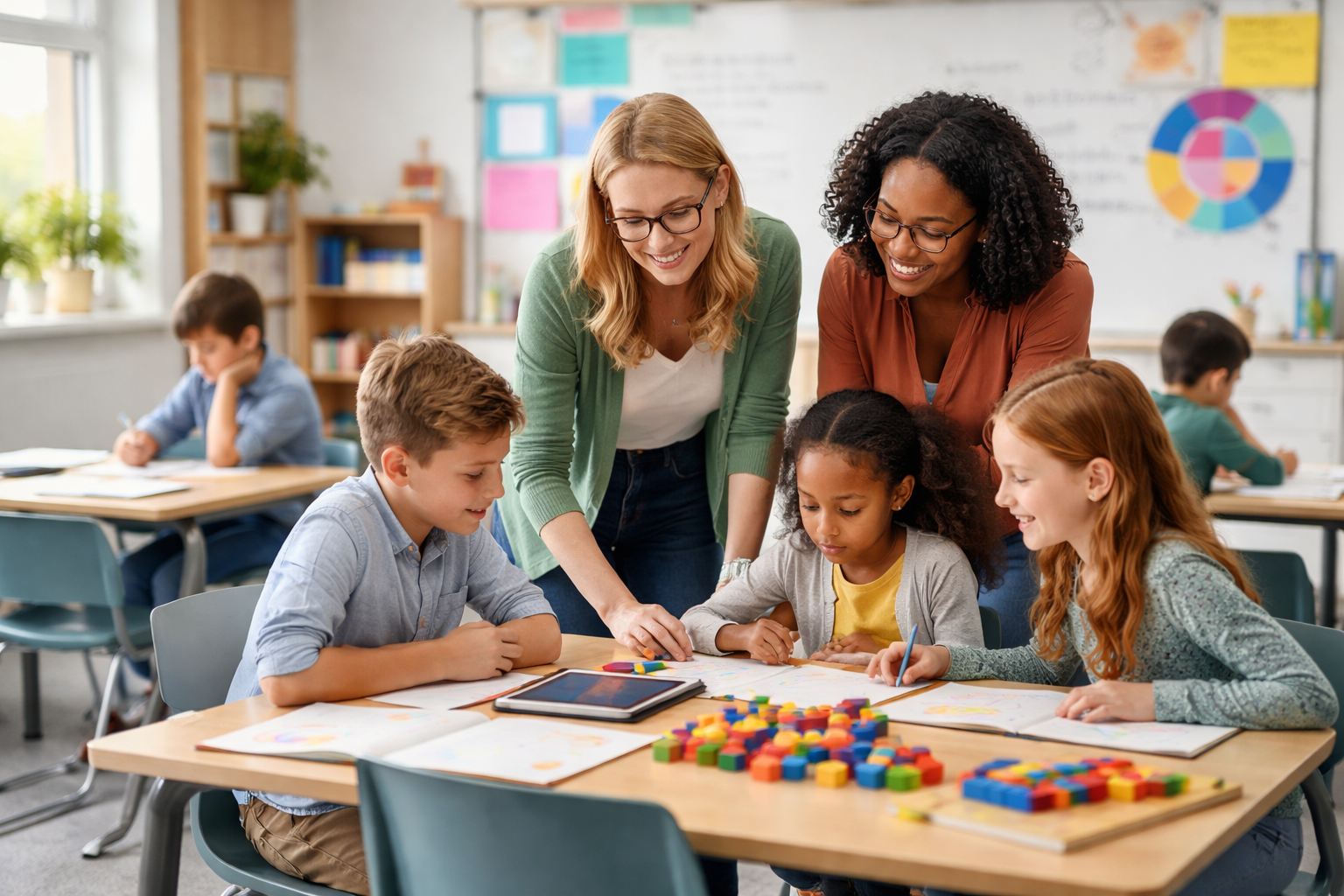
For years, gifted programming has followed a familiar rhythm. Students are pulled out of the classroom, given enrichment, and then sent back to grade-level instruction. It’s a model with real value. For many students, those moments of enrichment are where they feel most challenged and understood.
But here’s the tension. Those moments are often disconnected from the rest of the school day.
Gifted learners spend the majority of their time in the general education classroom. When the level of challenge in that setting does not match their readiness, something begins to shift. Engagement fades. Effort changes. In some cases, students who once showed strong potential begin to underachieve.
Recent conversations in the field, including Gifted and Underachieving: Exploring the Paradox with Dr. Michael Matthews (2026), continue to highlight how challenge and classroom experience shape student motivation. At the same time, research reminds us that underachievement is complex and influenced by both personal and environmental factors, especially how well instruction aligns with student needs (Desmet & Pereira, 2025; Finorita et al., 2025).
If gifted students need consistent challenge, why is so much of that challenge separated from their daily learning experience?
The Traditional Pull-Out Model: Where It Helps and Where It Falls Short
The pull-out model offers meaningful benefits:
Opportunities for advanced thinking
Time with intellectual peers
Space for creativity and exploration
Those experiences matter.
But they are often limited in time and, more importantly, disconnected from core instruction. Students may engage in rich thinking during enrichment, only to return to a classroom experience that does not reflect that same level of complexity or pace.
That disconnect creates inconsistency.
And consistency matters more than we sometimes realize.
Understanding Underachievement: It’s Not Just Motivation
Underachievement is often misunderstood as a lack of motivation. Research tells a different story.
Recent studies show that underachievement develops through a combination of internal and external factors, including motivation, learning behaviors, environment, and instructional experiences (Finorita et al., 2025; Desmet & Pereira, 2025). No single factor explains it.
Meta-analytic research further highlights the role of motivation and self-regulation, while emphasizing that these are shaped by the learning context students experience daily (Fong et al., 2023).
In other words, students are not operating in a vacuum.
Mismatch Matters
One of the most consistent findings across research is the idea of mismatch.
When instruction does not align with a student’s readiness, pace, or depth of thinking, engagement often declines. Students have identified this mismatch as a major contributor to underachievement, especially when work feels repetitive or lacks challenge (Desmet & Pereira, 2025).
Over time, that lack of challenge can influence:
Motivation
Effort
Academic identity
So instead of asking, “Why are these students unmotivated?”
A better question might be: Are students consistently experiencing the level of challenge they need?
Why Challenge Must Be Embedded, Not Occasional
Challenge that happens once a week is not enough.
Research on talent development and underachievement continues to emphasize that growth depends on ongoing, appropriately challenging opportunities, not isolated experiences (Subotnik et al., 2021).
When challenge is inconsistent:
Students may stop putting in effort
They may avoid risk or struggle
They may disconnect from learning
Not because they lack ability,
but because they have not been consistently asked to use it.
A Needed Shift: From Isolation to Collaboration
This is where the conversation shifts.
The issue is not simply pull-out versus push-in.
The deeper issue is isolation versus collaboration.
For too long, gifted programming has often operated separately from the core classroom. The gifted resource teacher provides valuable enrichment, but that work exists alongside, rather than within, daily instruction.
If we want consistent challenge, that structure needs to evolve.
A collaborative model brings the gifted resource teacher and classroom teacher together to:
Co-plan instruction
Embed advanced thinking into core lessons
Provide real-time differentiation
Respond to student needs as they emerge
This is not about eliminating enrichment.
It is about ensuring that challenge is not isolated from the learning environment where students spend most of their time.
The Role of the Gifted Resource Teacher Is Expanding
This shift redefines the role of the gifted resource teacher.
Instead of working primarily in isolation, the gifted resource teacher becomes:
A collaborative instructional partner
A specialist in advanced differentiation
A coach who supports classroom teachers
This aligns with growing work in gifted education that emphasizes coaching and collaboration as a way to build capacity across classrooms (Mofield & Phelps).
When the expertise of the gifted resource teacher is embedded within the classroom, it does not diminish the role. It expands it.
What Collaboration Looks Like in Practice
Collaboration is not just being in the same room. It is intentional and focused.
In a collaborative model:
Lessons are co-designed with multiple levels of complexity
Students are grouped flexibly based on readiness
Advanced learners engage in deeper, more complex tasks during core instruction
The gifted resource teacher supports extension in real time
This ensures that challenge is connected to what students are learning, not separate from it.
Why Collaboration Changes Outcomes
Research on interventions for underachievement shows that isolated strategies are rarely enough. What makes a difference is consistent, integrated support across settings (Steenbergen-Hu et al., 2020; Finorita et al., 2025).
Collaboration makes that possible.
When gifted support is embedded into the classroom:
Challenge becomes consistent
Engagement increases
Teachers build confidence in differentiation
Students experience growth as part of their daily learning
Most importantly, students begin to see school as a place where they are expected to think deeply every day.
Challenges to Consider
This shift is not simple.
Schools may face:
Scheduling constraints
Limited staffing
A need for professional learning
Resistance to changing established models
And collaboration requires intention.
Without it, efforts can become:
Unstructured
Surface-level
Inconsistent
But with clear purpose and planning, collaboration can transform how gifted learners experience school.
Getting Started: Small Shifts, Big Impact
This kind of change does not have to happen all at once.
Schools can begin by:
Piloting collaboration in one grade or subject
Prioritizing co-planning time
Using pre-assessment to guide instruction
Defining what meaningful challenge looks like
Building strong partnerships between teachers
Even small steps can lead to more consistent and meaningful challenge.
FAQs
Is pull-out programming still valuable?
Yes. It provides important opportunities for depth and peer interaction. However, it may not be sufficient on its own to ensure consistent challenge.
What is the role of the gifted resource teacher in a collaborative model?
The gifted resource teacher works alongside classroom teachers to embed advanced differentiation and support within daily instruction.
Does lack of challenge cause underachievement?
It is one of several contributing factors, particularly when combined with environmental and motivational influences.
Can schools use both models?
Yes. A blended approach that includes collaboration and targeted enrichment can be effective.
Final Thoughts
Gifted learners do not need more work. They need different work. Work that challenges them consistently, not occasionally.
For too long, gifted education has relied on structures that separate challenge from the core classroom experience.
But students do not learn in isolation.
And gifted education should not exist in isolation either.
When the gifted resource teacher and classroom teacher work together, challenge becomes part of the daily learning experience. It becomes connected, consistent, and meaningful.
That shift from isolation to collaboration has the power to change not just how we deliver gifted programming, but how gifted learners experience school every single day.
References
Desmet, O. A., & Pereira, N. (2025). High-Ability Students’ Perceptions of Underachievement.
Finorita, E. T., et al. (2025). Comprehensive Strategies for Enhancing Academic Achievement Among Underachieving School Students.
Fong, C. J., et al. (2023). Academic underachievement and its motivational correlates: A meta-analysis.
Steenbergen-Hu, S., et al. (2020). Interventions for underachievement in gifted students.
Subotnik, R. F., et al. (2021). Talent Development Megamodel.
Mofield, E., & Phelps, V. Collaboration and coaching in gifted education.
Gifted and Underachieving: Exploring the Paradox with Dr. Michael Matthews (2026). Podcast episode.
